StrategyJune 20258 min read
Your Biggest Competitor Just Launched Their AI Strategy
And that's OK. The goal is not to be first, it is to be deliberate.

By Khaled ShivjiFounder, Exec x AI

“Holding the line may be the best strategic choice you make this year.”
““You cannot overtake 15 cars in sunny weather, but you can when it’s raining” —”
Keep your nerve when the market surges
You’ve spent years locking horns with Contoso. Wherever your teams made progress, Contoso were right there.
Contoso chased every one of your strategic accounts, pitched every board, and hovered in the rearview mirror.
Just when you thought you’d pulled ahead, they’d reappear, usually at your customer’s HQ, offering a recovery plan if your team slipped up.
Earlier this morning Contoso’s CEO made a splash on Bloomberg. She unveiled Contoso’s sweeping new AI strategy. Buzzwords, bells and whistles, and five-point plans. Impressive to the untrained eye. But, you hope, hollow under the bonnet.
You sat down and paused. You’re reconciled yourself. You’re not ready to go public with your organisation’s AI roadmap; and that’s perfectly fine.
In fact, holding the line may be the best strategic choice you make this year.
When a rushed strategy backfires
You recall how Contoso swept up a contract you’d earmarked to keep H2 financials buoyant. During the after-action review, you just couldn’t explain how they did it!
Your commercials were competitive. The proposal was based on a solid, tried and tested plan. The customer’s CEO Bob mentioned your proposal was outstanding.
So all that was left was for Bob to sign. Except he didn’t.
Everything went quiet until Contoso’s LinkedIn feed lit up with a new announcement “Contoso wins deal to accelerate AI-powered R&D”.
The lost business was felt hard. Sales executives cancelled family holidays to plug the gap. Resentment built. The pressure bled into Q3.
Later that day your phone rang. It was Bob. He’d seen Contoso’s Bloomberg pitch and was spitting venom.
A few months ago, during the bid process, Contoso privately unveiled their AI strategy to Bob and his team. Under the guise of an NDA, they promised an “AI-designed crankshaft”.
Contoso claimed they could compress 150 years of patents and research papers into just a few months’ of AI-powered modelling to design and build a new, lighter and more durable crankshaft.
But it failed. Instead of streamlining performance, the crankshaft triggered a phased recall of thousands of generator sets.
The fix? Weeks out of service. Unacceptable in today’s high-demand infrastructure climate.
Bob paused for your response. You had an answer. Your own R&D chief, Amal spent the past year refining a self-learning model using your own maintenance and performance data.
Amal didn’t invent a new crankshaft; she used AI to conduct deep research into the data and re-engineered the torque profile for an OEM part.
The AI identified that a 3-degree angle shift could extend the part’s lifespan by 32%. No retooling. Just field-side adjustments.
Hours, not days. Precision, not promise.
The client called it a “relief.” You called it Q3 recovery.
Outcomes-based thinking wins
The difference wasn’t just the data; it was how you and Amal used it. You weren’t chasing buzzwords. You were managing outcomes.
Anthony Ulwick’s Outcomes-Based Innovation provides a playbook here. Described in his book What Customers Want, AI success ought to be measured on the basis that it delivers what customers *actually* want.
Shorter time to cash. Lower risk. Greater control.
Contoso sold “AI-designed parts.” You delivered reliability.
Contoso engineered ambition. You engineered uptime. And in the age of AI, those differences compound quickly.
If the world’s most advanced consumer tech company can pause to get things right, so can you
“We do see AI as a long-term transformational wave, as one that’s going to affect our entire industry, and of course, our society for decades to come. We wanna get it right. There’s no need to rush out the wrong features, and the wrong product just to be first” — Craig Federighi. SVP Software Engineering, Apple Inc. Interview with the WSJ, June 13, 2025
If your AI strategy isn’t live yet, don’t panic. Apple delayed *Apple Intelligence* to refine how its models give customers what they want. Why?
- Microsoft and Google learned the hard way. For all of the advantages it brings, AI is a tool that humans need to learn how to control. Apple developed a working prototype of Siri powered by *Apple Intelligence*. However, Apple tested it and deemed the reliability and error rate unacceptable. They made a conscious decision to delay until it met their internal bar.
- Apple realised that its initial architecture, while functional, lacked the scalability and stability needed to support the AI assistant’s full feature set with the required level of polish. They made a strategic decision to pivot toward a second-generation platform.
- Jony Ives’ design philosophy requires technical integration and very robust privacy controls (*Ed. Note —* if you’ve ever been locked out of your Apple Account, you’ll know what I mean!). Apple’s unified ecosystem synchronises devices and operating systems. But it results in longer development timelines.
- Speed was deprioritised in favour of durability, privacy, and reliability. Apple knew that these were some of the problems that many other AI early adopters had faced (McKinsey’s Quantum Black listed these within their report ‘The State of AI’). Knowing their reputation was at stake, Apple ranked integrity over competitive urgency.
“Contoso engineered ambition. You engineered uptime. And in the age of AI, those differences compound quickly.”
Play the long game. You’ll still be standing when the hype clears
Not a single week goes past without another big announcement about AI. It’s bewildering and it leaves many execs wondering when the right time is to utilise AI to 10x their share price.
They feel they have to move fast because consumers are tuning out. Gartner’s Hype Cycle for Emerging Technologies (2024) predicted generative AI will fall into the trough of disillusionment. I strongly agree with Gartner.
It doesn’t mean consumers won’t use new generative AI tools. But now consumers are more AI-savvy. They will ask: *Will this AI work in my world, with my constraints and at my pace?*
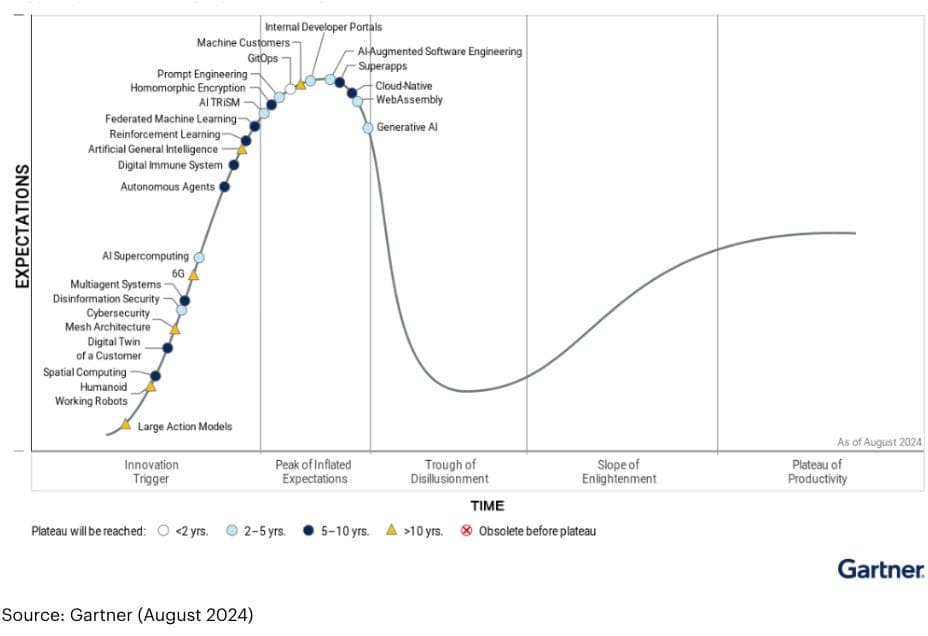
Its no wonder Apple pushed back the rollout. If consumers collectively decided that the new Siri powered by Apple Intelligence was a dud, it would have damaged Apple’s brand and share price.
Better to get it right first time than suffer a meme backlash.
Test, build, and avoid the noise
This is the time to work with your teams to design and refine your AI strategy. And there are plenty of resources that will help you along the way.
And don’t forget that our sister company, SAIL (Solutions and AI for Lawyers) is on hand to help — whatever department you lead, SAIL’s expert advisors, solutions architects, and development teams will empower you to update and refresh your organisation’s AI strategy. [Book a consultation now by clicking on this link](https://outlook.office.com/bookwithme/user/6da781ce38b04981a849c291e9a29db0@sail.legal?anonymous&ismsaljsauthenabled&ep=pcard).
Useful links
Seizing the Agentic AI advantage (QuantumBlack AI by McKinsey)
How to build a Successful AI Strategy (IBM)
Five Key Principles for Implementing an AI Strategy Across Your Organisation (Microsoft)
How to build an effective AI strategy (Google Cloud)
Afterword
QuantumBlack by McKinsey’s The State of AI report (March 2025) revealed that respondents increased their risk management programmes to cope with one of the three ‘big risks’ that AI had created for their organisations: inaccuracy, cybersecurity and intellectual property infringement.
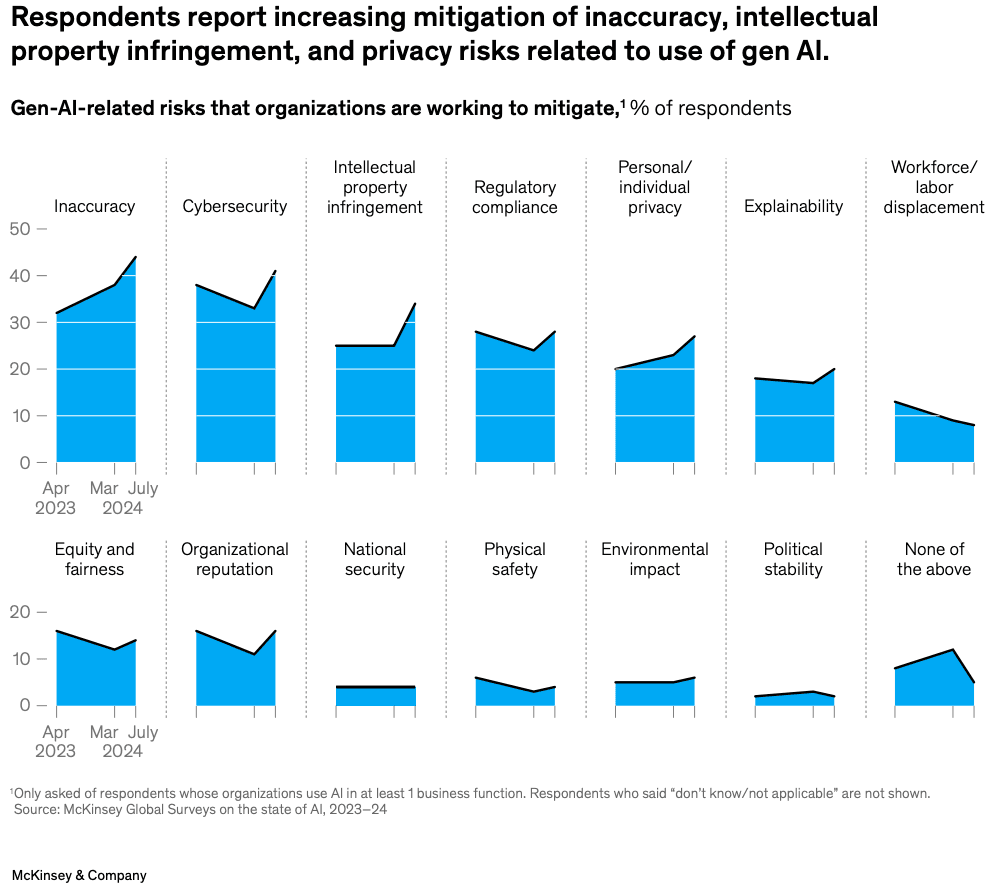
AI strategies don’t fail in isolation; they unravel where risk goes unnoticed, whether buried deep in the code or hiding in plain sight around the boardroom.
*When you buy something using the retail links in our stories, we may earn a small affiliate commission. Read more about how this works.*