LegalJune 20258 min read
Stop Treating Legal Like a Cost Centre: Agentic AI Is Ready to Deliver ROI
Four strategic workflows to improve legal speed, reduce risk, and unlock capital in 18 weeks.

By Khaled ShivjiFounder, Exec x AI

“Legal departments are underutilising their most powerful ally: agentic AI.”
Legal departments are underutilising their most powerful ally: agentic AI. Not just copilots. Full workflows, executed autonomously. With governance, at scale.
Legal’s Missed Opportunity
Legal remains hamstrung due to professional conduct rules, a lack of regulatory certainty about using AI to deliver legal services, legacy workflows, and governance bottlenecks. The cost is compounding daily.
Legal departments sit on untapped operational efficiencies and risk mitigation levers. They handle thousands of contracts, manage high-risk litigation, and interpret evolving regulation. These are not compliance burdens; they are performance multipliers, if structured properly.
In-house legal teams can deliver material returns across the balance sheet. Agentic AI, unlike static copilots can:
- execute workflows end to end,
- review contracts,
- extract clauses,
- trigger escalations, and
- adapt outputs based on contextual risk.
Organisations who fail to invest in providing legal departments with AI and agentic AI platforms are literally leaving millions on the table in unrealised opportunities:
- Delayed revenue recognition due to slow contract approvals.
- Excessive provisioning for regulatory penalties or litigation.
- Lost time navigating fragmented compliance updates.
- Duplicated effort across legal and commercial functions.
According to McKinsey’s agentic AI report, organisations that scale across eight dimensions can unlock 3–5x ROI over isolated pilots. In legal, those gains map directly to enterprise value.
The Eight Dimensions of ROI in Legal AI
To quantify and sustain impact, legal AI must be implemented across eight core dimensions. Here’s how each contributes to measurable returns (for our executive readership, we’ve aligned these with GAAP principles):
1. Strategy. Shifting from exploratory pilots to strategic programmes allows legal departments to align AI with enterprise objectives. AI tied to strategic KPIs such as reducing DSO or litigation backlog, directly affects revenue recognition and liability reduction.
2. Unit of Transformation. AI should be mapped to full business processes, not individual use cases. For example, automating the end-to-end contract lifecycle reduces time-to-revenue. This is a direct lever on the balance sheet under accrual accounting rules.
3. Delivery Model. Embedding legal into cross-functional AI squads prevents siloed innovation. When legal aligns with commercial, compliance, and finance, contract AI becomes a driver of margin improvement, not just risk reduction.
4. Implementation Process. Industrialised deployment of agentic AI enables cost amortisation and capital efficiency. Instead of multiple point solutions, one orchestrated platform delivers exponential returns across regions and departments.
5. People. AI doesn’t replace counsel, it unlocks their capacity. Consider the impact and benefits of Human-in-the-loop (HITL) versus human-out-of-the-loop (HOTL) agents. Firms that retrain teams to design, supervise, and interpret agentic AI outputs report faster time to insight and higher-value advisory work, improving labour productivity KPIs.
6. Governance. Agentic AI introduces new risks: prompt injection, hallucinations, escalation gaps. But done right, governance frameworks prevent agent sprawl, reduce operational risk and meet the control requirements auditors expect under COSO.
7. Technology Architecture. Legacy systems block AI’s full potential. Building an interoperable layer especially one that integrates with contract, risk, and compliance data, prepares legal for scalable automation and cloud-native resilience.
8. Data. Legal data is notoriously fragmented. Standardising inputs and creating reusable data products accelerates model training, reduces errors, and improves audit readiness impacting provisioning accuracy on the balance sheet.
“There is no point bolting on an AI lab to legacy processes. Agentic AI needs to be embedded across the enterprise, horizontally, cross-functionally, and from the ground up”
Explainer: Copilots vs. Agents
Most office workers confuse agentic AI with office productivity copilots. They are not the same.
Copilots, like Microsoft 365 Copilot or Gemini for Google Workspaces assist employees within applications. They summarise, suggest, and support. But they do not act autonomously.
Agentic AI systems can initiate and complete multi-step workflows with minimal oversight. They are, as the WEF describes them: *“autonomous systems that perceive their environment, process information and take actions to achieve specific goals”.*
But most enterprises are not ready to adopt them. Why?
- Legacy systems lack APIs and cannot communicate with agentic platforms.
- Process knowledge is undocumented, trapped in emails, SharePoints, Google Drives, and corporate laptops (*Ed. Note —* the D: drive of death!).
- Removing human-in-the-loop oversight triggers compliance red flags.
- POC inertia delays enterprise-scale deployment.
- Confusion over which agentic platform to use: There are at least six categories of agents: simple reflex, model-based, goal-based, utility-based, learning agents and hierarchal agents (or multi-agent systems). The WEF published an excellent executive briefing which describes these in more details - we’ve hyperlinked it here.
Four Agentic AI Workflows for Legal
Our sister company Solutions and AI for Lawyers (SAIL) has researched and modelled hundreds of in-house legal processes and reimagined them through the lens of agentic AI. Four stand out in their ability to move the needle quickly:
1. Contract Lifecycle Automation (CLM)
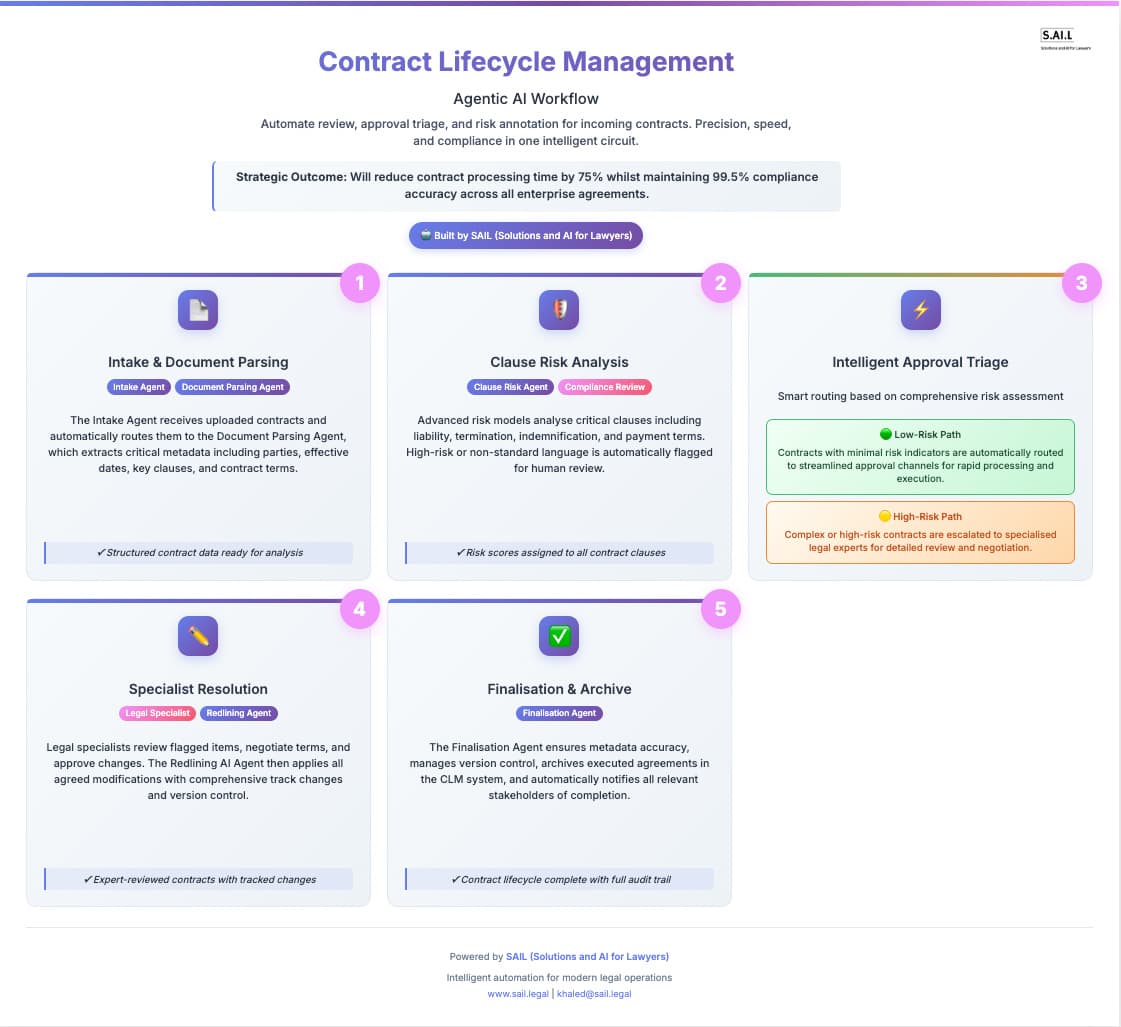
*ROI: Accelerates deal cycles, shortens DSO, improves working capital.*
Agentic AI ingests third-party templates, extracts clause data, flags deviations, and routes escalations. When integrated with Salesforce or procurement systems, contract status can inform cash flow forecasts. Legal moves from cost centre to revenue enabler.
2. Litigation Risk Assessment (Early Warning Radar)
“By focusing on outcomes instead of capabilities, they're transforming legal from reactive service desk to strategic business partner.”
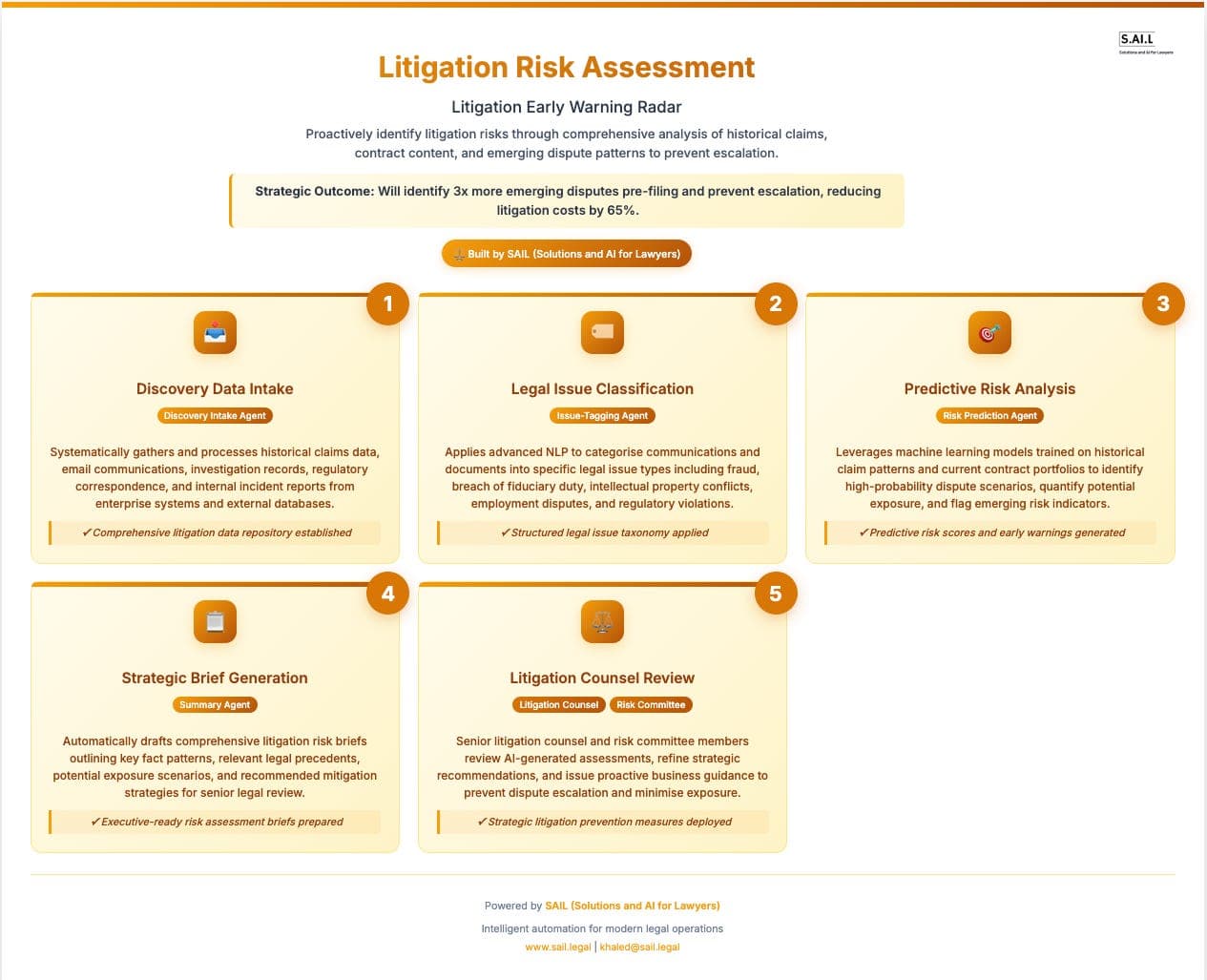
*ROI: Reduces litigation exposure, lowers provisioning, improves legal forecast accuracy.*
AI monitors claim patterns, escalates anomalies, and creates early-stage heatmaps. GCs can quantify risk weeks in advance providing valuable information for informing board reports, providing investor guidance, and reserve management.
3. Regulatory Change Monitoring and Compliance Surveillance
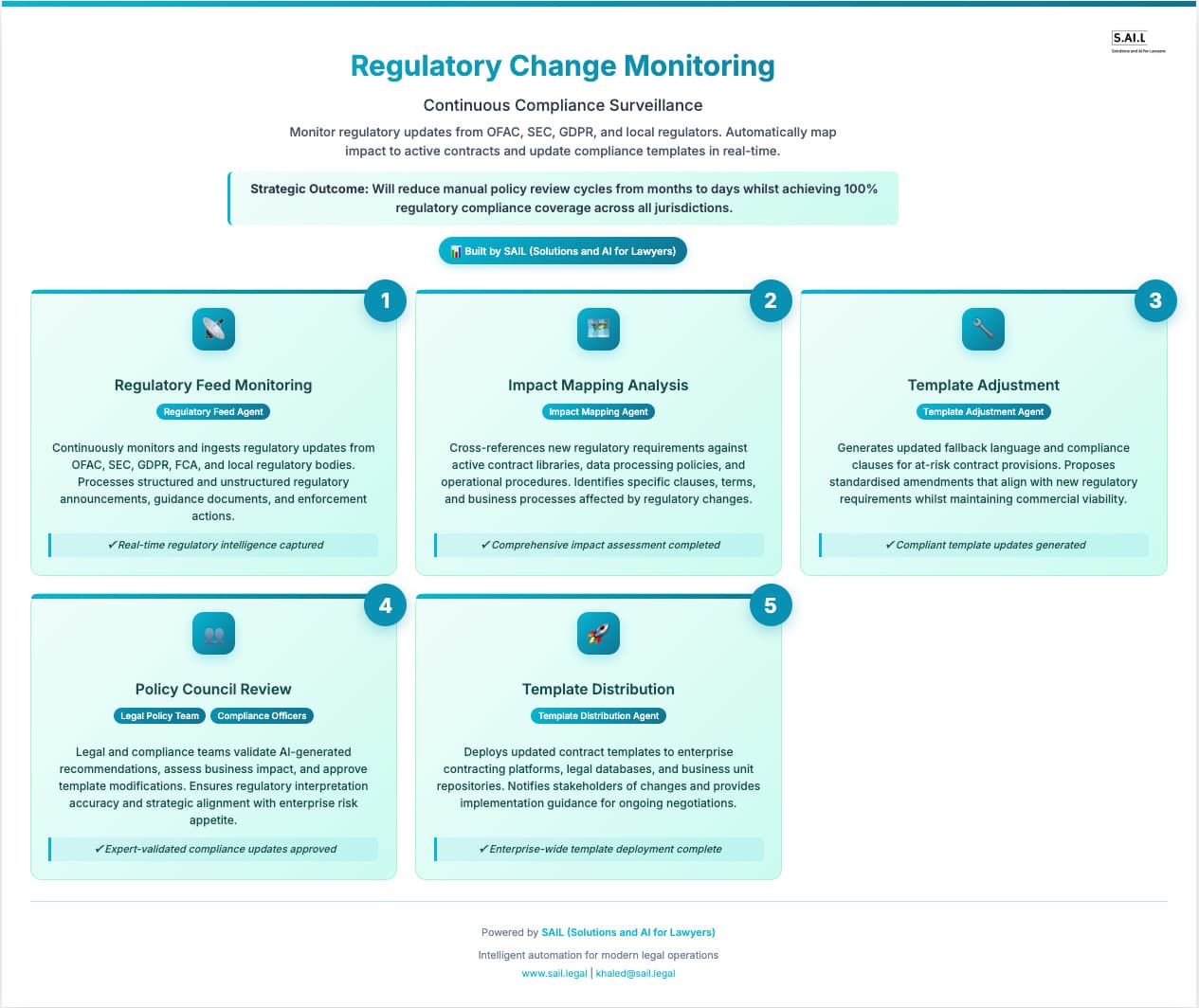
*ROI: Ensures compliance posture, avoids fines, lowers cost of compliance.*
Agentic systems parse new regulations from multiple jurisdictions, flag changes, assess applicability, and propose control updates. This lowers external legal spend and improves audit resilience.
4. IP Licensing Health Check
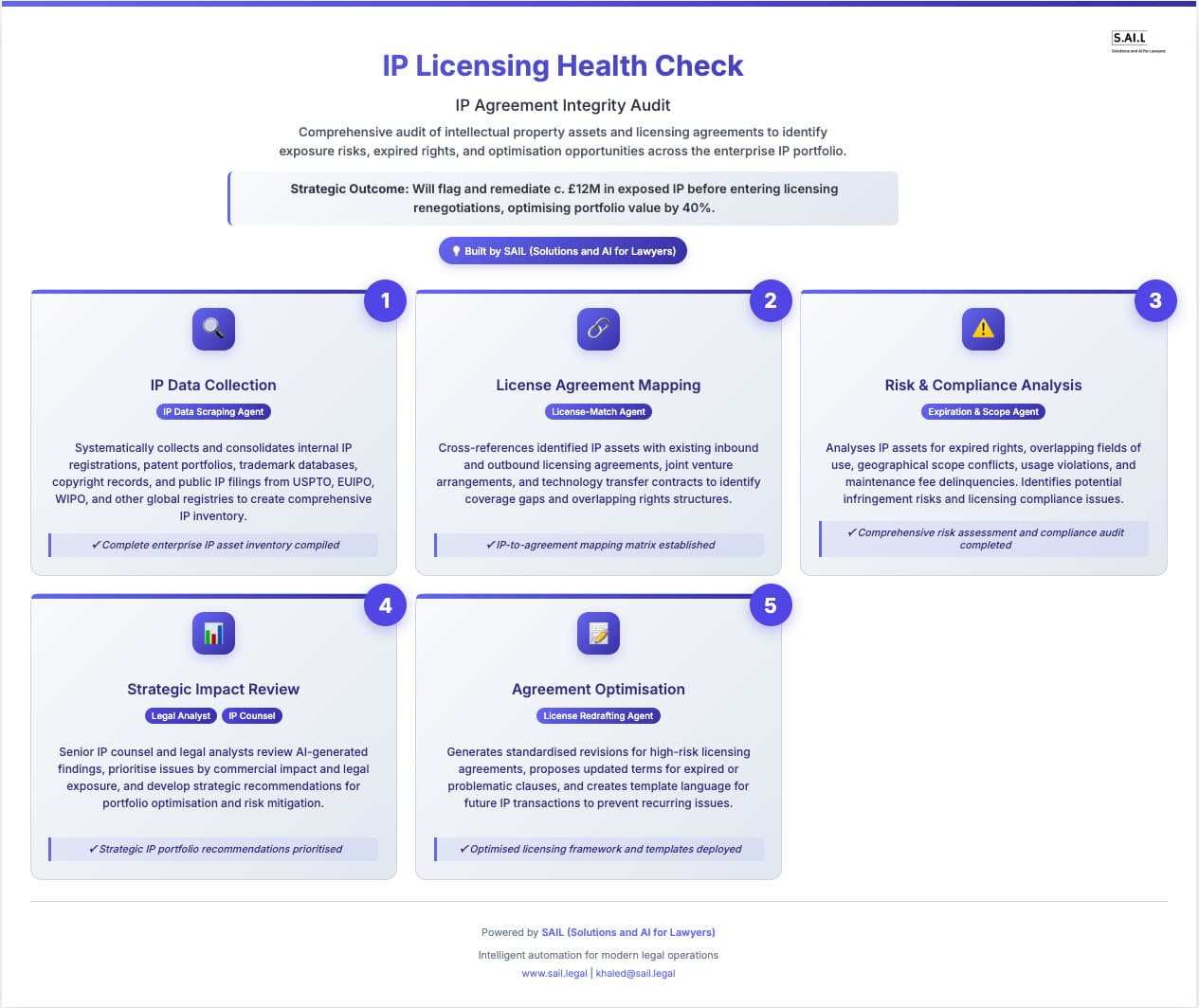
*ROI: Accelerates monetisation, ensures IP coverage, prevents leakage.*
AI agents route inbound licensing requests, extract key metadata, trigger approvals, and auto-populate licensing databases. Legal can scale monetisation without scaling headcount.
These tools and automation workflows are available for legal departments today. The organisations piloting these workflows report implementation times of under 5 months and full ROI within the financial year. By focusing on outcomes instead of capabilities, they’re transforming legal from reactive service desk to strategic business partner.
How SAIL Helps
SAIL (Solutions and AI for Lawyers) exists to help legal departments move from pilots to performance. Our legal-first AI framework targets implementation time at 18 weeks, with ROI measurable in under 12 months.
We fuse legal insight with operational delivery. No translation layer required. Our proprietary library of agentic workflows, compliance-first architecture, and data readiness playbooks get you to value fast, without compromising trust.
📩 Ready to explore what agentic AI can unlock for your legal team? Contact us at khaled@sail.legal or forward this post to your CIO, CFO or General Counsel.