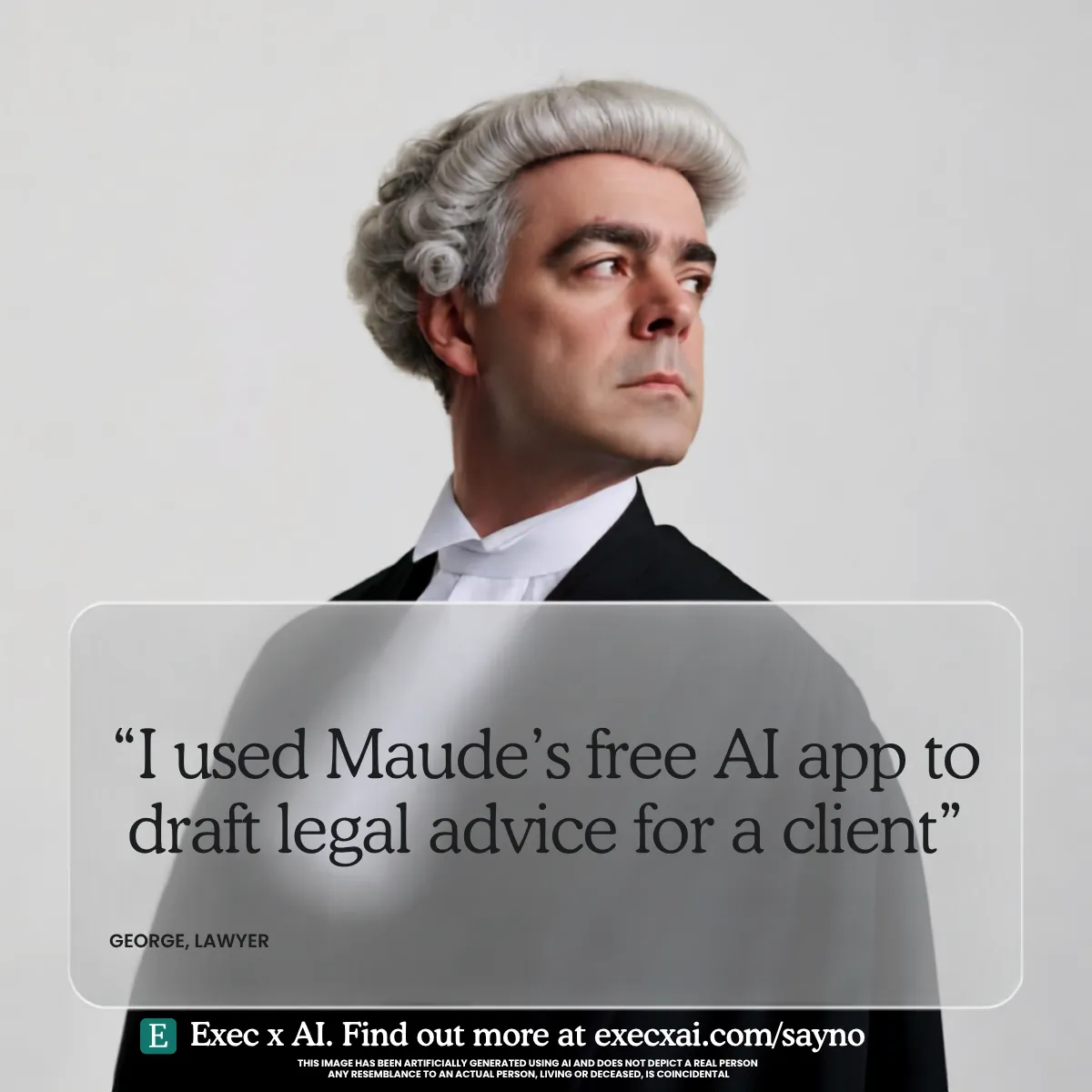
I used Maude's free AI app to draft legal advice for a client
George, Lawyer
Why this one is dangerous
George has done two things at once. He has given a consumer app material that belongs to his client, and he has asked a system that owes no duty to anyone to do work that carries a professional duty to someone.
Privilege is built on confidentiality. The free tier of a consumer AI tool is not confidential. Its terms typically allow the provider to retain prompts, review them, train on them and disclose them. Reference 11
The work product is the second exposure. Generated citations that do not exist, quotations that were never written and law from the wrong jurisdiction all read fluently until someone checks. Reference 12
What the courts have already done
In February 2026 a federal court in New York held that documents a defendant had prepared with a consumer AI tool were not protected by privilege. The reasoning was simple. The free tier's terms let the provider keep and disclose what was entered, so there was no reasonable expectation of confidentiality, and entering the material was a disclosure to a third party. One trial court, one jurisdiction, and the law is unsettled. The direction is not. Reference 11
The hallucination record is no longer anecdote. A public database tracked 2,022 court decisions involving fabricated citations or invented authority by 5 September 2026, across the United States, Canada, Australia, the United Kingdom and beyond. Lawyers have been fined, ordered to pay costs, referred to regulators and, in one case, struck off. Reference 12
How to combat it
Written for the partners, CISOs and IT directors who own the firm's controls, not only for the lawyer in the picture.
- Block the free tiers at network and device level, and tell the firm you have. Nobody accidentally uses a tool that does not open.
- Give every fee earner a sanctioned tool from day one. The firms with the least shadow AI are the ones where the approved tool is the best tool available.
- Write the rule at the level of data, not tools. Client identifying material never enters a system the firm does not hold a contract with.
- Require verification of every generated citation against a primary source, and make the lawyer who signs the document accountable for it by name.
- Run a no fault disclosure route. A lawyer who tells you what they used is your detection system working.
The safer route
The answer is not to keep lawyers away from AI. It is to buy the version with a contract attached.
The enterprise tiers of the frontier models are different products from the free apps wearing the same names. Anthropic states that inputs and outputs from its commercial products, including Claude for Work, are not used to train its models by default. OpenAI states the same for ChatGPT Enterprise and Business, alongside SOC 2 Type 2 audits, encryption in transit and at rest, and administrator controlled retention. Legal technology built on those models adds matter level access controls and audit trails inside the firm's own tenancy. References 1315
A tool under contract gives the firm what the free app cannot. Terms it can point to when privilege is questioned, and a log it can point to when a citation is.
Every person shown in this campaign is AI generated. Any resemblance to any person living or dead is purely coincidental.
The product names in the captions are invented and are used for satire. They are not real products. They are not associated with, endorsed by, or intended to identify any real company, product or service. Where the campaign's guidance refers to real services, it states only the providers' own published positions, linked to source, as at the date shown.